
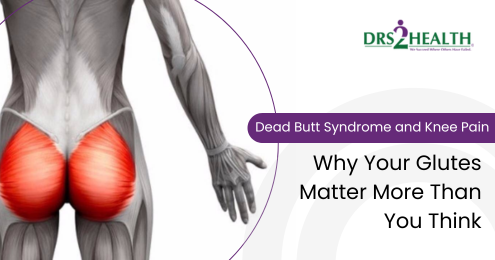
Many people chase knee pain solutions where the pain shows up—around the kneecap, inside the joint, or along the ligaments. But in a surprising number of cases, the knee is not the problem. It’s the messenger.
Hidden behind persistent knee discomfort is a quiet, modern condition known as Dead Butt Syndrome, clinically referred to as gluteal amnesia. It doesn’t announce itself loudly. Instead, it slowly alters how the body moves, shifts load to the wrong joints, and quietly increases stress on the knees.
Understanding this connection can completely change how knee pain is treated—and prevented.
The Modern Movement Problem No One Talks About
Human bodies are built for movement, but modern life trains us to sit. Long hours at desks, in cars, and on couches place the hips in a flexed position for most of the day. Over time, this position changes how muscles behave.
The glute muscles—especially the gluteus maximus and gluteus medius—are designed to stabilize the pelvis and control leg movement. When they remain inactive for hours, the nervous system adapts. Signals weaken. Activation fades. The muscles don’t “shut off,” but they stop responding when needed.
This is the foundation of dead butt syndrome.
What Dead Butt Syndrome Really Means (In Simple Terms)
Dead butt syndrome does not mean the glutes are weak because of lack of strength. It means they are under-communicating with the brain.
Think of it like this:
- The muscle still exists
- The muscle still has strength potential
- But the brain no longer calls on it at the right time
When that happens, the body looks for help elsewhere.
The Chain Reaction That Reaches the Knee
The knee is not a stabilizing joint. It’s a hinge. Its job is to bend and straighten—not to control rotation or side-to-side movement.
When the glutes fail to activate:
- The hips lose stability
- The thigh bone rotates inward
- The knee tracks off-center
- Stress increases on cartilage, ligaments, and tendons
Over thousands of steps, squats, or runs, this misalignment leads to pain.
This is why knee pain often appears without a clear injury—and why scans sometimes show “nothing wrong.”
Why Knee Pain Often Persists Despite Treatment
Many conventional approaches focus on the knee itself:
- Knee braces
- Anti-inflammatory medication
- Rest without movement correction
- Isolated knee-strengthening exercises
These methods may reduce symptoms temporarily, but they do not correct the faulty movement pattern. The glutes remain inactive. Compensation continues. Pain returns.
This is why people often say, “I rested, but the pain came back.”
Subtle Signs Your Glutes Are Not Doing Their Job
Dead butt syndrome rarely announces itself directly. Instead, it shows up as patterns.
You may notice:
- Knee pain during stairs, running, or standing up
- Tight hip flexors or lower back discomfort
- Poor balance on one leg
- Quads or lower back are doing all the work during workouts
- Difficulty feeling your glutes engage
These signs are not random—they’re connected.
Why Active People Are Not Immune
A common misconception is that dead butt syndrome only affects sedentary individuals. In reality, many runners, cyclists, and gym-goers experience it.
Why?
- Repetitive movement patterns
- Skipping proper warm-ups
- Overtraining dominant muscles
- Ignoring activation work
If the glutes are not consciously engaged, even intense exercise can reinforce poor movement habits.
The Brain–Muscle Disconnect Explained Simply
Muscles rely on frequent use to maintain strong neural connections. When a muscle is rarely activated:
- The brain reduces priority signals
- Movement patterns shift
- Other muscles take over
This is why simply “strengthening” the glutes is not enough. They must be reintroduced to the movement conversation.
Why Fixing the Glutes Often Reduces Knee Pain
When glutes begin firing correctly:
- The hips stabilize
- The thigh tracks properly
- The knee moves in alignment
- Load distributes evenly
This reduces strain on the knee without touching the knee directly.
Many people notice improvement within weeks once glute activation becomes consistent.
A Practical Reset: Waking the Glutes Back Up
Reactivation is about awareness before intensity.
Effective strategies focus on:
- Slow, controlled movements
- Mind–muscle connection
- Stability before strength
Exercises like controlled hip bridges, lateral movements, and single-leg balance work retrain timing—not just power.
Consistency matters more than volume.
Everyday Habits That Keep the Problem Alive
Even the best exercise routine can be undone by daily habits.
Contributors include:
- Sitting for hours without breaks
- Slouching or tucking the pelvis
- Locking knees while standing
- Avoiding hip movement
Short movement breaks every 30–60 minutes make a measurable difference.
Ergonomics: The Silent Influencer
Workspace setup plays a bigger role than most people realize.
Helpful adjustments:
- Feet flat on the floor
- Hips slightly higher than knees
- Neutral spine support
- Alternating sitting and standing
Ergonomics don’t fix the problem alone—but they stop making it worse.
When Knee Pain Is a Warning, Not a Failure
Pain is information. In the case of dead butt syndrome, knee pain is often the body’s way of saying:
“Something above me isn’t working.”
Listening to that signal early prevents long-term joint damage.
When to Involve a Professional
Self-correction works for many people, but professional support is important if:
- Pain limits daily movement
- Symptoms worsen with activity
- There is a history of injury or surgery
- Swelling or instability is present
Movement specialists assess how the whole body works—not just where it hurts.
Preventing Dead Butt Syndrome Long-Term
Prevention is not about doing more—it’s about doing things regularly.
Key principles:
- Daily movement variety
- Regular glute-focused strength work
- Conscious posture
- Balanced training
Glute activation should be routine, not reactive.
Final Perspective: Strong Glutes, Resilient Knees
Dead butt syndrome may sound lighthearted, but its effects are serious. When the glutes stop guiding movement, the knees take on forces they were never designed to handle.
By restoring proper glute function, knee pain often improves—not because the knee was weak, but because it was overloaded.
Healthy movement starts at the hips. Strong, responsive glutes are not optional—they are foundational.
Disclaimer
This article is for awareness only. Do not self-medicate. Always consult a qualified Naturopathic doctor for proper advice and treatment.

Dr. Dorette Lewis-Senior, ND, is a naturopathic doctor at DRS2Health in New York. She focuses on holistic and personalized care, helping patients address the root causes of health concerns through naturopathic medicine, nutrition, and lifestyle support.